
An EV battery pack is most vulnerable when it is not in a vehicle. It may sit in a warehouse for weeks, move through several handoffs, and cross borders with no active thermal management. Most pack-level incidents during this phase trace back to one of three causes: the wrong state of charge (SOC), an uncontrolled storage environment, or rough handling.
This guide is for OEM procurement teams, logistics managers, and warehouse operators. It explains how to set a safe SOC window, what a compliant warehouse looks like, and how to handle packs in transit.
Why SOC Is the First Safety Decision
Unlike most stored goods, lithium-ion batteries can act as both fuel and ignition source. Higher SOC means more stored energy and a more severe outcome if a cell fails.
Marine insurers have reached the same conclusion. A September 2026 IUMI technical guidance document on lithium-ion battery warehouse storage notes that, in line with FM Global research, batteries stored at 30% SOC or below show significantly reduced fire severity and a lower likelihood of thermal runaway.
SOC also affects battery life. Practical consequences include:
- High SOC in storage increases internal stress and accelerates calendar aging, especially in warm conditions.
- Very low SOC risks over-discharge, because the BMS and self-discharge continue to draw power during storage.
- Unverified SOC is a hidden risk. A pack labeled “30%” that actually sits at 60% changes both the safety and the regulatory picture.
Recommended SOC Windows by Scenario
No single number fits every situation. The table below summarizes common practice. Always confirm the exact window against your supplier’s datasheet and handling manual.
| Scenario | Typical SOC guidance | Key notes |
|---|---|---|
| Standalone pack by cargo aircraft (UN3480) | 30% or below (regulatory) | Required under US rules; larger packs may need competent-authority approval |
| Sea or road shipment | About 30%–50% (industry practice) | Check carrier, insurer and customer requirements |
| Short-term warehouse storage (under 1 month) | Per supplier datasheet | Avoid continuous charging; keep records |
| Long-term warehouse storage (over 3 months) | About 30%–60% (common supplier guidance) | Periodic voltage and SOC checks; avoid both full charge and deep discharge |
| Pre-installation or commissioning | Charge to the vehicle’s operating window | Run diagnostics before fitment |
For air transport, the rule is explicit. PHMSA’s rulemaking requires lithium-ion cells and batteries to ship at not more than 30 percent SOC aboard cargo-only aircraft when not packed with or contained in equipment. Batteries under UN3481 (packed with or contained in equipment) remain authorized on passenger aircraft above 30% SOC. Details are in PHMSA’s lithium battery air transport FAQ and the original Federal Register interim final rule. dotdot
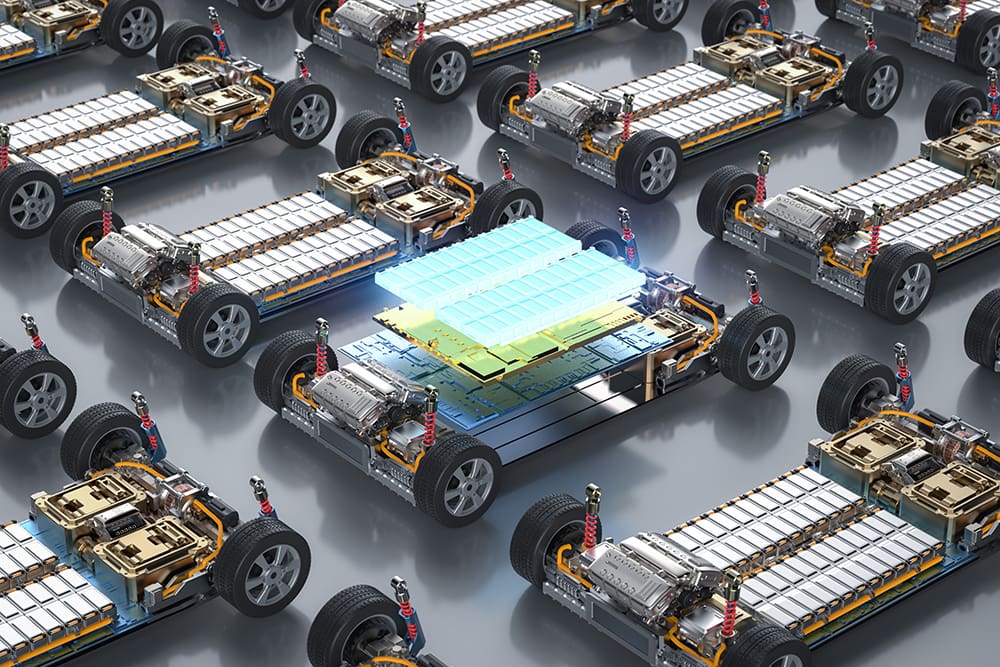
A note on LFP chemistry. Lithium iron phosphate (LFP) cells have a very flat voltage curve, so SOC cannot be read reliably from voltage alone. Warehouse staff who only measure terminal voltage may misjudge SOC by a wide margin. Pack-level SOC reporting from the BMS is far more dependable. LEAPENERGY’s proprietary BMS delivers SOC accuracy under 3%, which is why we recommend reading SOC from the BMS rather than estimating it. For more on why this matters, see our article on why SOC accuracy matters to EV battery pack buyers.
Warehouse Storage: What a Safe Facility Looks Like
A battery warehouse is not a general-cargo warehouse. Four principles apply: control the environment, separate higher-risk stock, detect early, and keep an emergency plan.
Core practices:
- Keep temperatures moderate. Many manufacturers recommend roughly 10°C–25°C for long-term storage. Avoid direct sunlight and heat sources.
- Keep the area dry and ventilated. Condensation and standing water are risks to connectors and housings.
- Do not charge or run test cycles in the storage area. Use a dedicated, supervised charging zone.
- Stack only as the packaging allows. Never exceed the rated stacking height, and never stack pallets on exposed terminals.
- Quarantine damaged or returned packs. The IUMI guidance recommends that damaged or returned batteries be stored outside the warehouse building at a safe distance.
- Align with fire codes. NFPA 855 covers the design, installation, operation and maintenance of stationary energy storage systems, including the storage of lithium-ion batteries. Check local fire code requirements for your jurisdiction.
| Control area | Good practice | Why it matters |
|---|---|---|
| Incoming inspection | Check packaging, housing damage, labels, and SOC on arrival | Catches transit damage before packs enter stock |
| Temperature and humidity | Moderate, non-condensing environment with logging | Slows aging and protects connectors |
| Segregation | Separate zones for new, aged and damaged packs | Limits fire spread and mix-ups |
| Detection and response | Automatic fire detection, temperature alarms, emergency removal plan | Early warning is the best mitigation |
| Charging policy | No charging or testing in the storage area | Removes a common ignition scenario |
| Inventory rotation | First in, first out with periodic SOC and voltage checks | Prevents deep discharge on forgotten stock |
For storage over three months, a quarterly inspection cycle is widely used. Record the SOC, voltage, temperature and any visual change on each pack, and keep a storage file for each batch.
Transport Handling: Compliance and Physical Care
Know the regulatory baseline
Every lithium battery shipment starts with testing. UN Manual of Tests and Criteria, Section 38.3 defines the tests, including altitude simulation, thermal cycling, vibration, shock, external short circuit and overcharge, that cells and batteries must pass before they can be shipped. LEAPENERGY’s EV battery packs are UN 38.3 certified, and IEC 62660 and UL 2580 documentation is available on request.
Beyond testing, shippers should confirm:
- The correct UN number and proper shipping name (UN3480 for standalone batteries, UN3481 for packed with or contained in equipment)
- Required marks, labels and documents for the chosen transport mode
- The SOC limit for air freight and any carrier-specific restrictions
- Special approvals for large packs, which are rarely moved by air
Protect the pack physically
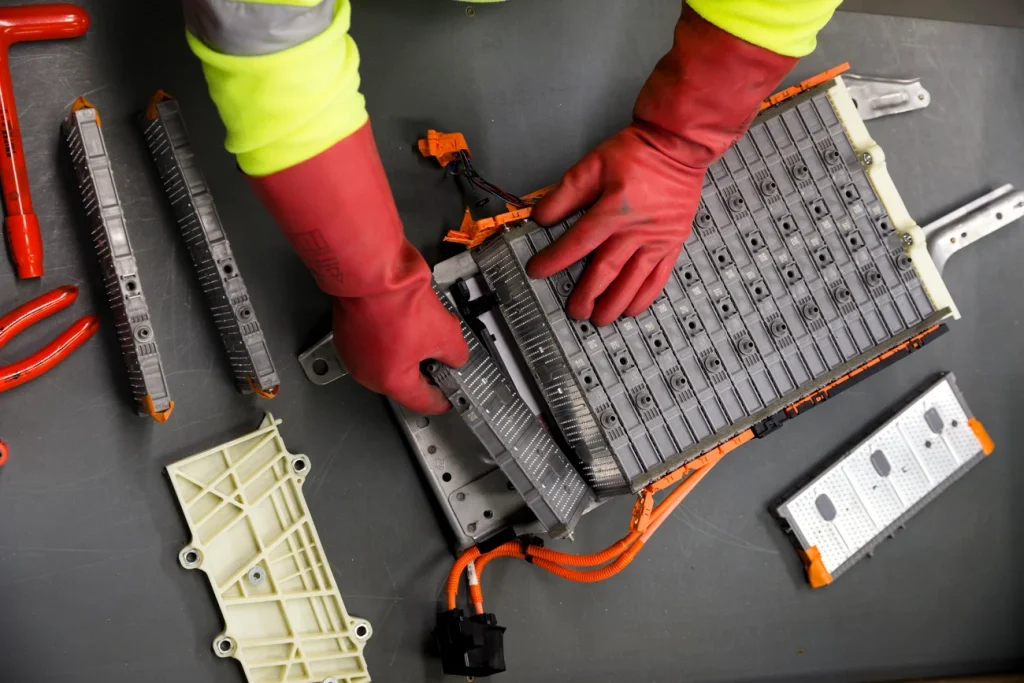
Packs are heavy and carry high-voltage components. Handling guidelines include:
- Use rated lifting equipment. Lift only at designated points, with forklifts or hoists rated for the pack weight.
- Prevent impact and crushing. Use fixed cradles, edge protection and anti-slip surfaces. Avoid stacking beyond the packaging rating.
- Control vibration. Secure packs to prevent movement in the container or truck.
- Protect connectors. Keep covers and sealing caps in place until installation.
- Monitor if possible. For high-value or long-haul shipments, temperature and shock loggers provide evidence if a claim arises.
- Brief the crew. Drivers and forklift operators should know the emergency procedure and who to call.
How Pack Design Supports Safer Storage and Transport
The best handling procedure still depends on a pack that was built to tolerate stress. Several design features of the LEAPENERGY EV/REEV battery pack reduce risk during the idle and transit stages:
- Multi-layer safety validation. The pack is tested through more than 40 abuse tests, including a 100 kN crush test and a 5 m drop test, with a 130-second pack fire test and no thermal propagation.
- Robust enclosure. A high-strength steel housing and a standard IP67 protection rating suit dusty and humid environments.
- Thermal control. Liquid cooling keeps cell temperature difference within 2°C during operation, and the platform is tested across -40°C to 55°C.
- AI-driven BMS. SOC accuracy under 3% and fault pre-warning more than 30 days ahead help warehouses verify stored packs and catch drift early.
- Integrated BMU and BDU. The BDU controls contactors, manages pre-charge, and provides emergency disconnect, which reduces exposed wiring and failure points.
Quality checks before shipment matter just as much. Our guides on end-of-line testing, insulation monitoring and cell voltage consistency explain what OEMs should verify before accepting a delivery.
Partner With LEAPENERGY for Safer EV Battery Pack Supply
Source Battery Packs Built for Safe Storage, Shipping and Integration
LEAPENERGY has manufactured EV battery systems since 2015 as part of the LEAPMOTOR group. Our 400V and 800V packs cover 40 kWh to 100 kWh, support 1.8C, 2.2C and 4C fast charging, and use LFP technology with CTP and CTC designs. Every pack includes an intelligent BMS with CAN/RS485 communication and remote diagnostics. Sample delivery takes 3–4 weeks, mass production 6–8 weeks, and the MOQ is 5 units. Share your platform and logistics requirements with our engineers and get a quote within 24 hours. Contact LEAPENERGY today.
FAQ
1. What is the safest SOC for storing EV battery packs?
Many suppliers recommend roughly 30%–60% SOC for long-term storage, and insurers favor 30% or below for warehouse risk reduction. Check the supplier’s datasheet for your specific pack.
2. Is 30% SOC mandatory for all battery shipments?
No. The 30% limit is a regulatory requirement for standalone lithium-ion batteries on cargo-only aircraft. Sea and road shipments follow different rules, but many shippers still use low SOC as a precaution.
3. How often should stored packs be inspected?
A quarterly inspection cycle is common for long-term storage. Check SOC, voltage, temperature and visible condition, and log each result.
4. Should I charge packs while they are in the warehouse?
No. Charging and testing should take place in a dedicated, supervised area, not in the storage zone.
5. What certifications should I ask for before shipping a pack?
At minimum, a UN 38.3 test summary. LEAPENERGY packs are UN 38.3 certified, and IEC 62660 and UL 2580 documents can be provided on request.
 English
 German
 Chinese
 Spanish