The UAE is building its electric mobility market on a clear policy footing. The National Electric Vehicles Policy sets out, among its goals, a 20 percent reduction in transport-sector energy consumption, and charging networks are expanding alongside it. Behind every new EV sits a battery pack, yet a Research and Markets report notes that only a handful of manufacturers in the UAE can produce ev battery pack, with combined output of roughly 1 GWh per year. In practice, most packs reaching Emirati roads and fleets come from global suppliers, supported by a small group of UAE-based makers.
This guide ranks ten manufacturers by influence. For the global names we used 2025 installation data from SNE Research, as reported by CnEVPost: out of 1,187 GWh installed worldwide, CATL held 39.2%, BYD 16.4% and LG Energy Solution 9.2%. We also confirmed that each global company appears in market research listings of UAE EV battery participants. LEAPENERGY, a pack and system specialist, follows them, and three UAE-based manufacturers close the list. Some of the UAE-based entries serve EV-adjacent segments rather than passenger-car packs, and we say so where it applies.
Climate also shapes supplier choice. A Society of Automotive Engineers (SAE) technical paper modelled a 60 kWh NMC pack under Riyadh summer conditions of up to 47 °C and highlighted adaptive thermal management and temperature-aware charging as essential for Gulf deployment. Keep that in mind as you compare the profiles below.
Quick Comparison Table
| Rank | Company | Founded | Headquarters | Core EV battery focus | UAE angle |
|---|---|---|---|---|---|
| 1 | CATL | 2011 | Ningde, China | LFP and NCM packs, CTP, sodium-ion | Named in UAE market research |
| 2 | BYD (FinDreams Battery) | 1995 (FinDreams 2019) | Shenzhen, China | Blade Battery (LFP) | UAE vehicle sales since 2023; Masdar storage deal |
| 3 | LG Energy Solution | 2020 | Seoul, South Korea | Pouch, cylindrical and prismatic cells | Named in UAE market research |
| 4 | SK On | 2021 | Seoul, South Korea | High-nickel pouch cells and packs | Named in UAE market research |
| 5 | Panasonic Energy | 2022 (roots to 1935) | Osaka, Japan | Cylindrical 2170 and 4680 cells | Named in UAE market research |
| 6 | Samsung SDI | 1970 | Yongin, South Korea | Prismatic cells and packs | Named in UAE market research |
| 7 | LEAPENERGY | 2015 | China | EV/REEV/PHEV packs, 400V and 800V | Custom pack supplier |
| 8 | Thunderbolt | 2021 (company statement) | Dubai, UAE | Custom lithium packs | UAE-based assembler |
| 9 | Enercap | Not stated in sources | Dubai and Abu Dhabi, UAE | Supercapacitor energy storage | UAE-manufactured |
| 10 | Eternity Technologies | 2011 | Ras Al Khaimah, UAE | Industrial motive-power batteries | UAE-manufactured |
1. CATL
- Founded: 2011
- Location: Ningde, Fujian, China
- Core Products: EV battery systems (LFP and NCM), Cell-to-Pack (CTP) designs, Shenxing and Qilin series, TECTRANS commercial vehicle batteries, sodium-ion cells, energy storage
- Official Website: https://www.catl.com/en/
- Product Category: EV battery systems
CATL (Contemporary Amperex Technology Co., Limited) was established in Ningde in 2011 as a spin-off of the EV battery operations of Amperex Technology Limited, a business founded by Robin Zeng in 1999. Its first major automotive partnership, with BMW, followed in 2012. Today the company supplies EV battery systems that include cells, modules, enclosures and packs, across LFP and high-voltage nickel-based chemistries, along with energy storage products. SNE Research data reported by CnEVPost shows CATL installed 464.7 GWh in 2025, a 39.2% global share and the highest of any manufacturer. For UAE buyers the relevance is scale and breadth: market research on the UAE describes the EV market as shaped largely by global battery makers embedded in vehicle platforms, and it lists CATL first among them. CATL’s April 2026 Tech Day introduced a third-generation Shenxing superfast-charging battery, a third-generation Qilin battery and a Naxtra sodium-ion line, adding to a portfolio that already spans passenger and commercial vehicles.
Advantage Products: CATL’s CTP approach removes the module layer, and its Shenxing battery is built around high-rate charging; CATL says the third-generation version can charge from 10% to 98% in six minutes and 27 seconds. For logistics fleets, CATL rates its TECTRANS II battery for light commercial EVs at up to one million kilometres or ten years. These are manufacturer claims, so validate them against your own duty cycle and climate.
2. BYD (FinDreams Battery)
- Founded: 1995 (battery arm FinDreams Battery formed in 2019)
- Location: Shenzhen, China
- Core Products: Blade Battery cells and packs (LFP) for passenger EVs, buses and trucks; Haohan energy storage system
- Official Website: https://www.byd.com/
- Product Category: Blade Battery and BYD UAE battery overview
BYD was founded in 1995, and its battery arm, FinDreams Battery, was formed as a BYD subsidiary in 2019. FinDreams launched the Blade Battery in 2020, a lithium iron phosphate design in which long, thin cells, most commonly about 96 cm long and 9 cm wide, are arranged like blades inside the pack. BYD ranked second worldwide in 2025 with 194.8 GWh installed and a 16.4% share. Its UAE footprint is unusually direct. BYD entered the UAE passenger car market in June 2023 with the Atto 3 through Al-Futtaim, and in March 2025 it launched commercial vehicle models in the UAE equipped with Blade Battery technology. In July 2026, Argus Media reported that BYD signed an agreement with Masdar to supply 11.275 GWh of battery energy storage for a round-the-clock renewable energy project in Abu Dhabi, built on its 2,710Ah Blade cell. FinDreams also builds Blade cells and packs for buses, trucks, forklifts, and grid and residential storage.
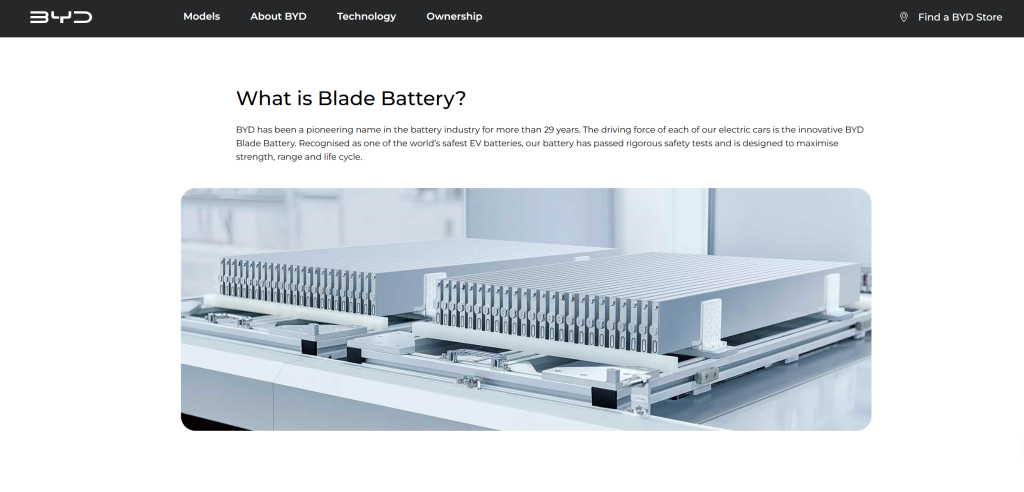
Advantage Products: The Blade Battery’s LFP chemistry is valued for thermal stability, which matters in hot-climate operation, and BYD reports that the cells pass nail-penetration testing without smoke or fire. In March 2026 BYD introduced Blade 2.0, described as a move from LFP to LMFP chemistry. Local vehicle availability through its UAE distribution partner is a practical advantage for fleets.
3. LG Energy Solution

- Founded: 2020 (spun off from LG Chem; lithium-ion research began in 1992)
- Location: Seoul, South Korea
- Core Products: Cylindrical, pouch and prismatic cells; EV modules, packs and battery management systems; energy storage systems
- Official Website: https://www.lgensol.com/
- Product Category: Automotive Battery
LG Energy Solution was formally established in December 2020 as a spin-off from LG Chem, but its battery roots date back to 1992, when lithium-ion research began, and it supplied the world’s first mass-produced EV batteries for the GM Volt in 2009. Headquartered in Seoul, it makes cylindrical, pouch and prismatic cells, along with modules, packs and battery management systems. Its cylindrical range includes the 2170 and 1865 formats, and it also offers energy storage batteries for grids, commercial sites and homes. In 2025 it installed 108.8 GWh, a 9.2% global share that ranked third behind CATL and BYD. Its automotive page describes platforms across voltage classes, from low-voltage systems of about 50 V up to commercial EVs near 800 V. Several market research reports on the UAE name LG Energy Solution among the leading participants. The company began producing cylindrical EV cells at its Arizona plant in 2024, a sign of how its capacity is spreading beyond Asia and Europe.
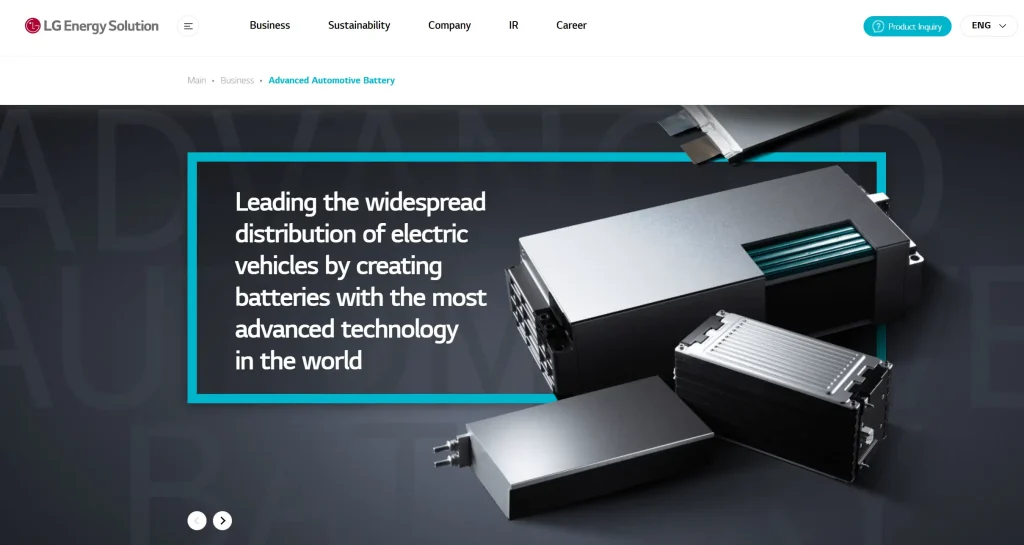
Advantage Products: LG Energy Solution offers pouch cells in varied lengths and widths, which gives pack designers packaging flexibility, and a tabless 2170 cylindrical cell designed for fast charging and high discharge. Pouch suits tailored form factors, while cylindrical suits compact, high-power layouts.
4. SK On

- Founded: 2021 (separated from SK Innovation)
- Location: Seoul, South Korea
- Core Products: High-nickel pouch cells; EV modules and packs; LFP pouch cells for energy storage
- Official Website: https://www.sk-on.com/
- Product Category: Official site, battery portfolio
SK On became an independent company in October 2021 after separating from SK Innovation. Based in Seoul, it built its reputation on high-nickel pouch cells and, according to SNE Research data, supplies Mercedes-Benz, Ford, Volkswagen and Hyundai. Its former parent, SK Innovation, supplied cells for the Hyundai Ioniq 5 and Kia EV6 platforms. In March 2025 it also agreed a supply deal with Nissan, the first Japanese carmaker to use its batteries. SK On installed 44.5 GWh in 2025, a 3.7% global share. The company has traditionally produced only pouch-type EV batteries, but at InterBattery 2025 it displayed pouch, prismatic and cylindrical cells, along with high-voltage mid-nickel and long-life LFP options, signalling a broader chemistry strategy. In 2026 it introduced four pack solutions: pouch CTP, large-area cooling CTP, an integrated pouch-prismatic pack, and an immersion cooling pack, and it also showed a high-energy-density LFP pouch battery for energy storage. A UAE market research report lists SK On among the battery makers influencing the UAE EV mix.
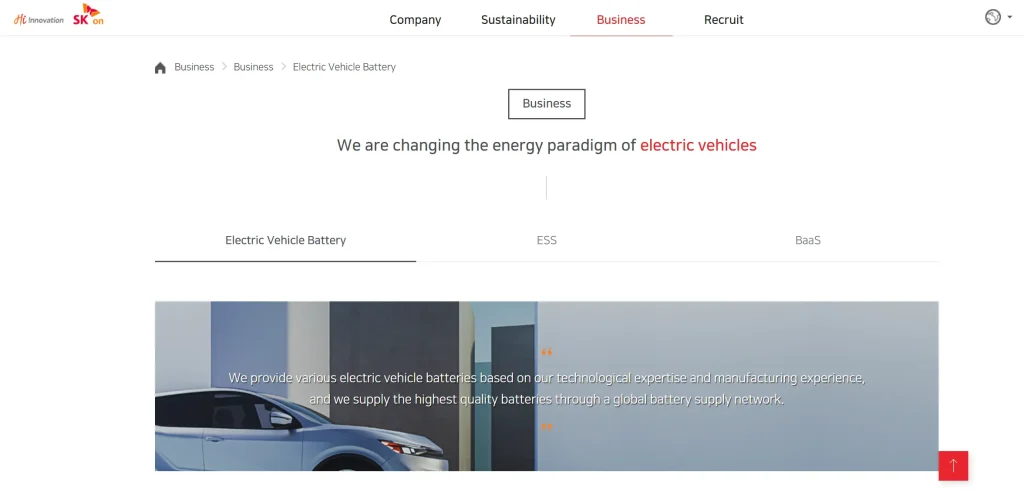
Advantage Products: SK On’s pack portfolio now includes several cooling architectures, which is worth examining for hot-climate programs because cooling design directly affects cell temperature spread. Its high-voltage mid-nickel pouch cell aims to reduce nickel and cobalt content while holding energy density.
5. Panasonic Energy
- Founded: April 2022 as a stand-alone operating company (battery lineage from 1935)
- Location: Osaka, Japan
- Core Products: Cylindrical lithium-ion cells for vehicles (18650, 2170, 4680); storage battery modules and systems
- Official Website: https://www.panasonic.com/global/energy/
- Product Category: Panasonic Energy company profile
Panasonic Energy Co., Ltd. was established as a stand-alone operating company in April 2022, though the group’s battery lineage runs back to National Storage Battery Co. in 1935, and SANYO became a wholly owned subsidiary in 2011. Its automotive business centres on cylindrical lithium-ion cells, the 18650 and 2170 formats, and it is best known as the cell supplier behind Tesla vehicles. The Nevada factory began operating in 2017, and a second North American plant in De Soto, Kansas, opened on 14 July 2025 with plans for roughly 32 GWh of annual capacity. Panasonic has also opened 4680 lines in Wakayama, Japan, although volume production has been reported as delayed. SNE Research data put Panasonic near 3.7% of global EV battery installations from January to November 2025. A UAE market research report lists Panasonic among key participants in the EV battery pack market, so it belongs in any shortlist of influential suppliers, even though it mainly supplies cells to automakers rather than catalogue packs.
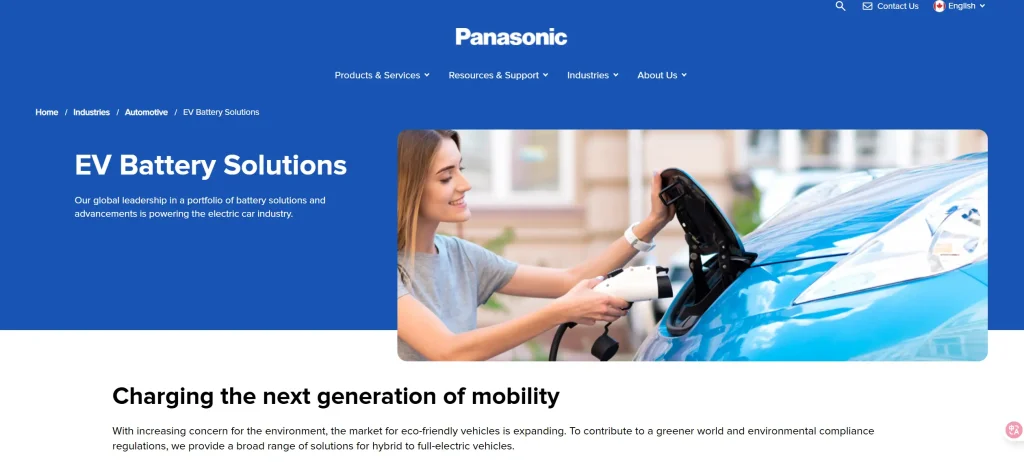
Advantage Products: The 2170 cell is Panasonic’s main volume product, and the company says its high-capacity cells offer industry-leading volumetric energy density. Cylindrical cells suit packs where energy density and mature, well-understood manufacturing matter most.
6. Samsung SDI
- Founded: 1970
- Location: Yongin, Gyeonggi-do, South Korea
- Core Products: Prismatic EV cells (PrismStack), battery packs for BEV, PHEV and HEV, cylindrical cells, energy storage systems
- Official Website: https://www.samsungsdi.com/business/index.html
- Product Category: Automotive Battery
Samsung SDI traces its origins to 1970 and is based in Yongin, Gyeonggi-do. It filed its first prismatic battery patent in 1998, completed a dedicated EV battery plant in Ulsan in 2010 and began mass production in 2011, choosing the prismatic format from the start. In March 2026 it introduced “PrismStack” as the brand name for its prismatic batteries and won an InterBattery award for a 700 Wh/L high-energy prismatic cell. Its automotive offering spans prismatic cells, modules and pack platforms for BEV, PHEV and HEV applications, including high-voltage systems developed with global OEMs. In August 2026 it signed an agreement with General Motors to jointly develop a next-generation prismatic cell for future EVs. Its cylindrical cells use high-nickel NCA material, and the company is accelerating prismatic LFP development. Samsung SDI appears among the key players in UAE EV battery market research from several firms, though its share of global installations is smaller than that of the Chinese leaders above it.

Advantage Products: Samsung SDI emphasises safety. It describes a No Thermal Propagation (No TP) technology intended to stop a single-cell failure from spreading, and a stack design that uses the prismatic can space efficiently. Its pack pages describe compact BEV modules and a liquid-cooled PHEV energy storage system.
7. LEAPENERGY

- Founded: 2015 (independent business since 2021)
- Location: China, with a manufacturing network covering China, Europe and Southeast Asia
- Core Products: EV/REEV/PHEV battery packs (400V and 800V), commercial vehicle batteries, BDU, BMS, low-voltage and 12V lithium batteries, commercial and residential energy storage
- Official Website: https://leap.hiitio.com/
- Product Category: EV/REEV Battery Pack
LEAPENERGY began in 2015 as the battery division of Leapmotor and became an independent lithium battery systems business in 2021. It develops and manufactures EV, REEV, PHEV and low-voltage batteries as well as battery energy storage systems, and it reports a manufacturing network with facilities in China, Europe and Southeast Asia. The company says it sold 292,200 battery packs in 2024, double its 2023 volume, and operates 18 automated production lines with MES-based, 100% inspection. Testing is supported by an in-house CNAS-accredited laboratory, and the company lists IATF 16949 certification. LEAPENERGY is a pack and system specialist rather than a cell maker: its EV pack platform is cell-agnostic, with main cell suppliers including CATL, CALB, Gotion, ZENERGY and EVE. We place it seventh because it is newer to export markets than the global cell makers above it, and we include it because its pack-level engineering suits UAE buyers who want customised 400V and 800V packs. For a deeper look at the structure behind these packs, see our guide to CTP and CTC technologies.
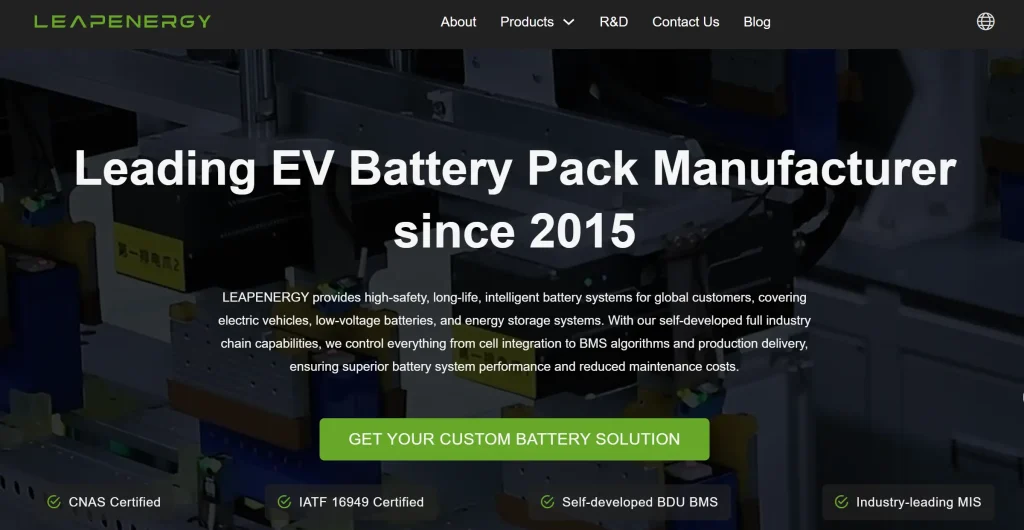
Advantage Products: The flagship EV/REEV Battery Pack covers 400V and 800V platforms with CTP and CTC structural options. The product page lists five pack variants from 52.9 kWh to 81.9 kWh, liquid cooling with a temperature difference of 2 °C or less, and IP67 protection as standard. The Gen3 BMS is built on AUTOSAR with ASIL D and ASPICE Level 2 targets. For UAE programs, liquid cooling and a tight temperature spread are directly relevant to heat management, and the platform’s 400V and 800V options let engineers match the pack to the vehicle architecture.
| Pack | Cell capacity | Energy | Nominal voltage | Fast charge, SOC 30% to 80% |
|---|---|---|---|---|
| PACK1 | 139 Ah | 52.9 kWh | 380.4 V | 30 min |
| PACK2 | 210 Ah | 69.9 kWh | 332.85 V | 30 min |
| PACK3 | 120 Ah | 81.9 kWh | 682.6 V | 15 min |
| PACK4 | 103 Ah | 67.7 kWh | 657.3 V | 15 min |
| PACK5 | 114 Ah | 74.9 kWh | 657.3 V | 15 min |
Source: LEAPENERGY EV/REEV Battery Pack product page. Volume utilization is listed at 79%, with 2070 × 1551.6 × 150 mm dimensions.
8. Thunderbolt

- Founded: 2021 (as stated by the company)
- Location: Dubai, UAE
- Core Products: Custom LiFePO4, Li-ion and LTO battery packs; e-bike and e-scooter packs; traction packs; UPS and solar storage packs; eVTOL and drone batteries
- Official Website: https://tbolt.ae/
- Product Category: Custom battery packs
Thunderbolt describes itself as a UAE-based custom battery pack manufacturer and direct OEM assembler with a dedicated assembly floor in Dubai. Its website says it designs and builds lithium battery packs of any voltage, capacity or size to customer specification, and it lists LiFePO4, Li-ion and LTO chemistries. The focus is bespoke work rather than mass-market EV packs: custom e-bike and e-scooter packs for micromobility fleets, UPS and solar storage, marine packs, and eVTOL and drone batteries, with the company stating it is certified to supply the aviation industry. Its project examples include a 48V traction pack for a robotics platform, and it says every pack is cycled on a load-test bench, ships with test logs, and includes a smart BMS with per-cell balancing. The company says it ships across the UAE and GCC. Small-batch, locally supported builds are the main attraction for UAE fleets, though buyers should confirm cell sourcing, certification scope and warranty terms directly.
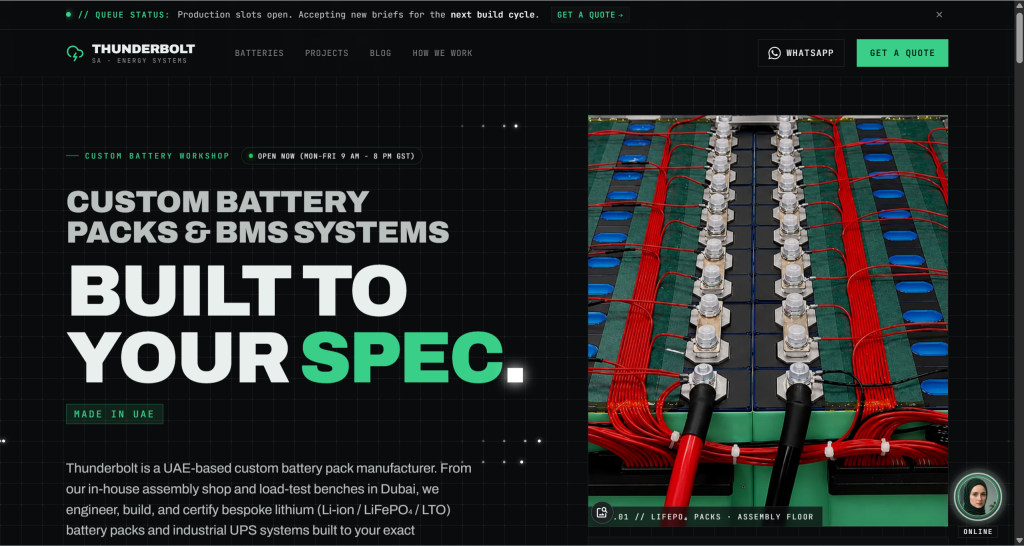
Advantage Products: Custom LiFePO4 packs are Thunderbolt’s strongest fit for the UAE climate. The company points to 3,000 to 5,000+ cycles and strong thermal stability for LiFePO4 in hot conditions, and it advertises custom-build turnaround from two working days.
9. Enercap

- Founded: Dubai-founded; founding year not stated in the sources we reviewed (joint venture with Apex Investment announced in September 2024)
- Location: Dubai Industrial City, with a new facility planned in Musaffah, Abu Dhabi, UAE
- Core Products: Supercapacitor-based energy storage, including the Enpack containerised system; EV-related energy storage applications
- Official Website: https://enercap.energy/
Enercap is a UAE energy storage manufacturer founded in Dubai and now a subsidiary of Abu Dhabi’s Apex Investment PSC, following a joint venture announced in September 2024. It is not a conventional lithium-ion maker. Its technology is a supercapacitor-based system that the company describes as non-chemical, free from lithium, electrolytes or graphene, relying on electrostatic storage for ultra-fast charging. In May 2025 it was reported that Enercap had begun producing fully UAE-manufactured advanced batteries for sectors including electric vehicles, and that its Dubai Industrial City plant has 12 GW of annual capacity, with a further 36 GW facility planned in Abu Dhabi. Enercap also formalised a partnership with ROX Motor at Make it in the Emirates 2025 to explore EV applications, and it agreed a 1 GWh sale to EPointZero. Because its core products target stationary and hybrid use cases, treat Enercap as an emerging UAE option for EV-adjacent applications, and ask for validation data before specifying it in a vehicle platform.
Advantage Products: Enpack is a containerised storage system offering up to 4.2 MWh of DC storage in a 40-foot container, according to the company. Supercapacitor modules suit applications that need very fast charge and discharge cycles, such as charging support and grid services.
10. Eternity Technologies

- Founded: 2011 (plant inaugurated April 2011; some sources cite 2009)
- Location: Ras Al Khaimah, UAE
- Core Products: Industrial motive-power batteries for electric forklifts and similar equipment, standby OPzS and OPzV batteries, gel batteries for renewable energy
- Official Website: https://www.eternitytechnologies.com
Eternity Technologies was set up by the Al Dobowi Group in Ras Al Khaimah, and its AED 200 million plant was inaugurated in April 2011 in the RAKIA Industrial Park. Al Dobowi describes itself as the largest battery manufacturer in the MENA region. Eternity’s focus is industrial motive power: batteries for electric forklift trucks, industrial cleaning machines, access platforms and personnel transport vehicles, plus standby batteries launched in 2014 and gel blocs for renewable energy. In 2021 it introduced Quasar, a thin-tube carbon nano motive battery. Its portfolio is mainly lead-acid, so it does not compete directly with lithium passenger-car packs, but it is a significant UAE manufacturer for electric industrial vehicles. The company says it supplies more than 100 countries and describes its products as up to 99 percent recyclable, which supports the UAE’s circular economy goals. We include it because UAE logistics, ports and warehouses rely on electric material-handling fleets.
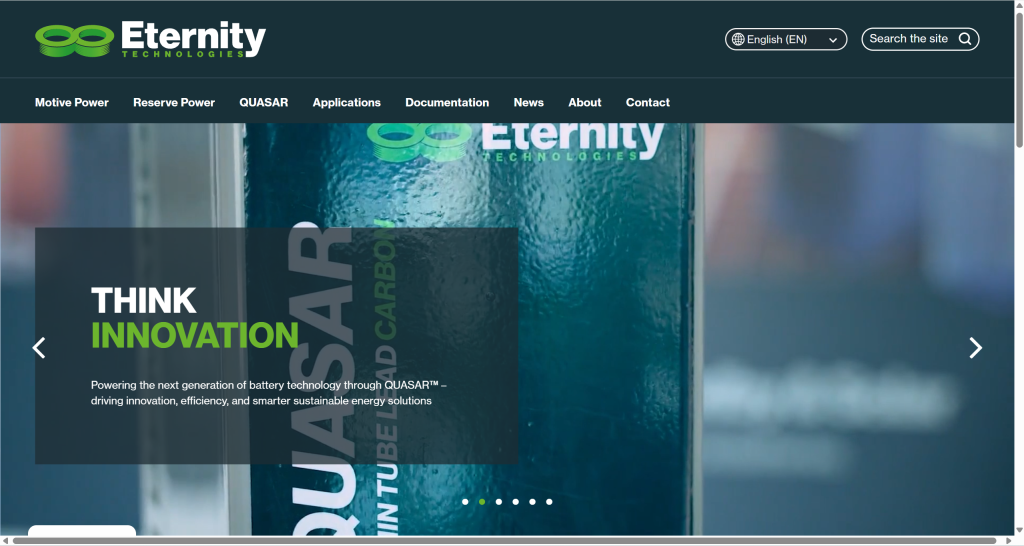
Advantage Products: The Quasar Gel Carbon Nano front-terminal range, offered in 100 Ah to 200 Ah capacities, combines VRLA gel with carbon nano tube technology, and the company says it delivers fast recharge and durability in high-temperature environments. Local manufacturing shortens lead times for industrial fleets.
How to Choose a Battery Pack Supplier for UAE Programs
Use the profiles above as a starting point, then test each shortlisted supplier on practical criteria:
- Thermal management: Ask for the temperature spread across the pack and the cooling method, since Gulf summers push packs hard. Our overview of EV battery thermal management systems explains the trade-offs.
- Voltage platform: Match pack architecture and charge rate to the vehicle; 400V and 800V packs behave differently in cost and charging time.
- Certification and documentation: Request test reports and certification scope in writing, and confirm what applies to your exact pack variant.
- Logistics: Imported packs are Class 9 dangerous goods, so plan shipping and customs early, using our guide to shipping and import rules for EV battery packs.
- Supplier vetting: Work through our checklist of essential questions for EV battery pack suppliers before you sign.
EXPLORE MORE LEAPENERGY BATTERY PACK
Build Your UAE EV Program with LEAPENERGY
If you are specifying EV, REEV or PHEV battery packs for a UAE program, LEAPENERGY can support you from early concept to validated samples. Our EV/REEV Battery Pack platform covers 400V and 800V architectures, liquid cooling with a temperature spread of 2 °C or less, and an AUTOSAR-based BMS, with CTP and CTC structural options. Standard packs are rated IP67, sample delivery typically takes 3 to 4 weeks and mass production 6 to 8 weeks, and the minimum order is 5 units, negotiable by project. Share your voltage platform, energy target, climate requirements and certification needs, and our engineers will respond with a tailored proposal; the product page promises a quote within 24 hours. Contact LEAPENERGY today to request your quote, or learn more about our engineering on the R&D page.
 English
 German
 Chinese
 Spanish