
An EV battery pack can pass every performance test and still sit at a port because the paperwork, labels or state of charge were wrong. For OEM buyers and logistics teams, transport compliance is part of the product. At LEAPENERGY, we build EV/REEV battery packs with UN 38.3 certification, and we see the same shipping questions again and again. This guide explains how Class 9 rules apply to EV packs, how the requirements differ by transport mode, and what to check before a pack crosses a border.
This article is general information, not legal advice. Dangerous goods regulations are revised regularly, so confirm the edition in force with your carrier or a qualified dangerous goods adviser.
Why EV Battery Packs Are Class 9 Dangerous Goods
Lithium-ion batteries are assigned to Class 9, miscellaneous dangerous goods, because of the fire risk when a cell fails. Before a cell or pack can ship, it must be of a type proven to pass the tests in Section 38.3 of the UN Manual of Tests and Criteria. The tests cover altitude simulation, thermal cycling, vibration, shock, external short circuit, impact or crush, overcharge and forced discharge. TÜV SÜD’s UN/DOT 38.3 overview lists the test types in detail.
Testing alone is not enough. In the United States, PHMSA’s lithium battery test summary guidance states that each manufacturer and later distributor of cells or batteries made on or after 1 January 2008 must make a test summary available. The same guidance says the summary does not expire, and a new one is needed only when the design changes enough to require retesting.
UN 38.3 is a transport test. It does not replace product safety standards such as UL 2580, and it does not replace a Safety Data Sheet.
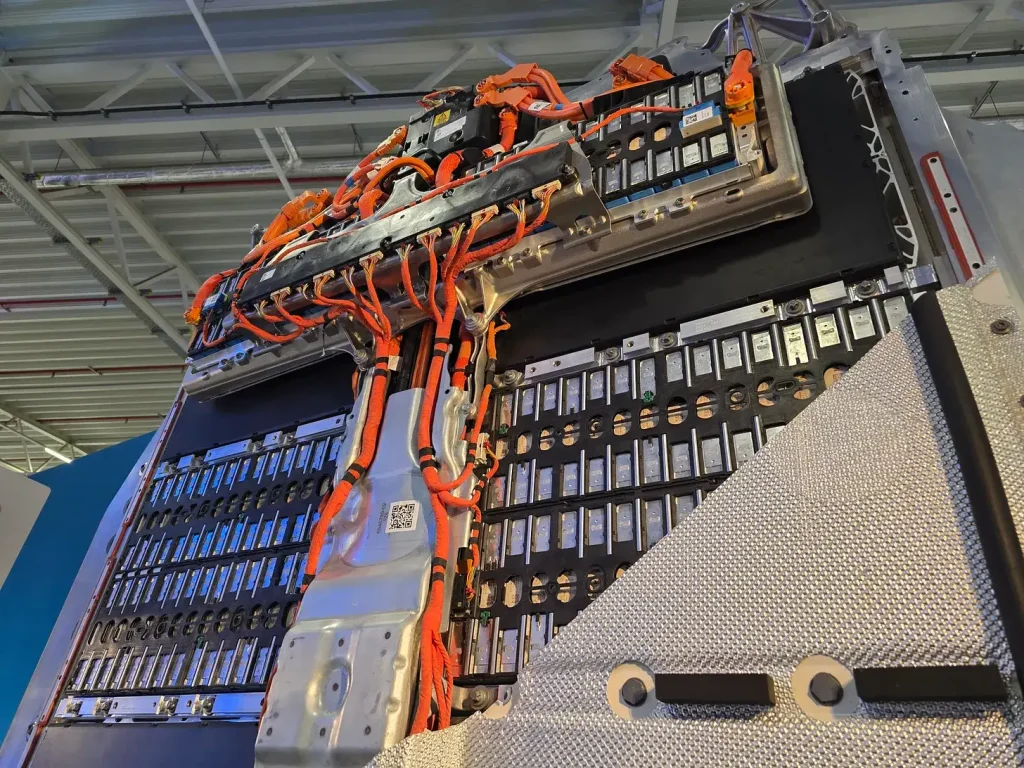
Step 1: Classify the Shipment Correctly
The UN number depends on how the battery travels, not only on what it is.
- UN3480: lithium-ion batteries shipped alone. PHMSA’s interpretation on EV batteries confirms that a pack removed from a vehicle and packed separately ships as UN3480.
- UN3481: lithium-ion batteries packed with or contained in equipment.
- UN3171 or UN3556: a complete vehicle with the battery installed. PHMSA classes it as UN3171, battery-powered vehicle, under US rules. Under the IMDG Code, a vehicle powered solely by lithium-ion batteries is routed to UN3556 instead. Check which entry your carrier uses.
- Damaged or defective packs: these fall under Special Provision 376 and need special packing (P908, or P911 for critical defects) plus a “Damaged/Defective” mark. IATA rules forbid air transport of batteries identified as defective or damaged.
Rules by Transport Mode
The table below summarizes common requirements for a standalone EV pack under UN3480. It is a starting point, not a replacement for the regulations.
| Mode | Governing rules | Typical packing approach | State of charge (SOC) | Points to watch |
|---|---|---|---|---|
| Air | IATA DGR, ICAO Technical Instructions | Packing Instruction 965; cargo aircraft only; passenger aircraft forbidden | 30% or below | Section IA limit is 35 kg net per package; heavier packs need State of Origin and Operator approval under Special Provision A99 |
| Sea | IMDG Code | P903 (LP903 for large batteries) | The code sets no SOC limit for normal shipments; carriers and insurers may ask for one | Class 9 lithium battery label; stowage rules apply |
| Road and rail (Europe) | ADR / RID | P903 | Confirm with the carrier | Requirements are revised every two years; thresholds trigger vehicle and driver rules |
| US ground | 49 CFR 173.185 | UN specification outer packaging, Packing Group II level | Confirm with the carrier | Batteries of 12 kg or more with a strong, impact-resistant casing may use strong outer packagings, protective enclosures or pallets |
Air freight deserves extra attention. Since 2016, standalone lithium-ion batteries (UN3480) on aircraft must be offered at no more than 30% SOC. According to Lion Technology’s summary of the 67th IATA DGR, from 1 January 2026 the 30% limit (or an indicated capacity of 25% for vehicles) also became mandatory for UN3481 and vehicle entries above 100 Wh. The FAA Lithium Battery Shipping Guide 2026 summarizes the cargo-aircraft-only rule, the 35 kg package limit and the shipper’s declaration. Because EV packs usually exceed 35 kg, most buyers move them by sea or road.
Documents, Marks and Labels
A clean document set prevents most delays. The next table lists the usual items.
| Item | What it covers | Who supplies it |
|---|---|---|
| UN 38.3 test summary | Test report ID, model, mass, Wh rating and responsible person | Pack manufacturer |
| Safety Data Sheet | Hazards, handling and emergency response | Pack manufacturer |
| Dangerous goods declaration or transport document | UN number, proper shipping name, Class 9 and mode-specific entries | Shipper |
| Class 9 lithium battery label and UN number marking | Hazard communication on the package | Shipper |
| Cargo Aircraft Only label | Required for air packages under PI 965 | Shipper |
| UN-specification packaging | Packaging tested to the required performance level | Shipper or packer |
Import and Market-Access Checks
Shipping rules move the pack; import rules decide whether it can be sold. Three checks matter most.
- Confirm the destination’s battery law. In the EU, Regulation (EU) 2023/1542 replaced the old Battery Directive and created an EV battery category, with CE marking and obligations for importers. TÜV SÜD’s guide to the regulation outlines the categories and requirements. A digital battery passport for EV batteries is due in 2027.
- Ask your customs broker about classification and local approvals. Duty codes, permits and inspection practice differ by country, and this article does not list them all.
- Match the document set to the consignee. Provide the UN 38.3 summary and, where required, UL 2580 or IEC 62660 documents before the vessel sails.
A Practical Pre-Shipment Checklist
- Verify the UN number against the transport mode.
- Read the SOC from the BMS, not from terminal voltage. LFP cells have a flat voltage curve, so voltage can mislead. Our guide to storage and transport handling for safe SOC covers this in depth.
- Confirm the packaging specification and the 12 kg strong-casing option, where it applies.
- Attach the UN 38.3 summary and the Safety Data Sheet to the booking.
- Ask the carrier about its own limits, since airlines and shipping lines can be stricter than the regulations.
- Run end-of-line checks before dispatch. See what OEMs should expect from end-of-line testing.
How LEAPENERGY Packs Support Compliant Shipping
According to our product pages, LEAPENERGY packs are UN 38.3 certified, and IEC 62660 and UL 2580 certificates can be provided on request. The standard pack protection rating is IP67. Key facts for procurement teams:
- Platform range: 400V and 800V packs from 40 kWh to 100 kWh, with LFP chemistry and CTP and CTC designs.
- Safety validation: more than 40 abuse tests, including a 100 kN crush test, a 5 m drop test and a 130-second pack fire test, with no thermal propagation.
- BMS accuracy: SOC accuracy under 3%, which supports reliable SOC verification before shipment.
- Integrated protection: the BDU manages contactors and pre-charge and provides emergency disconnect.
- Testing capability: an in-house CNAS laboratory; see our R&D page for validation equipment.
- Commercial terms: samples in 3–4 weeks, mass production in 6–8 weeks, MOQ of 5 units.
Get Shipping-Ready EV Battery Packs From LEAPENERGY
Compliance is far easier when your battery partner prepares the documents with the product. LEAPENERGY has manufactured EV battery systems since 2015, and our engineers can share UN 38.3 documentation, discuss SOC and packaging requirements for your route, and customize pack structure, size, electrical specifications and interfaces for your platform. Tell us your destination, transport mode and vehicle platform, and we will respond with a quote within 24 hours. Ask for the test summary for your exact model so your forwarder has it before booking. Contact LEAPENERGY or email sales@hiitio.com to start.
FAQ
Is a UN 38.3 test summary mandatory for EV battery packs?
Yes, for shipping. UN 38.3 testing is the baseline for lithium batteries in transport, and PHMSA guidance says the manufacturer or later distributor must make the test summary available.
Does the UN 38.3 summary expire?
PHMSA states it does not expire. A new summary is needed only when a design change requires retesting.
Can I ship a full-size EV pack by air?
Often not without approval. Section IA of Packing Instruction 965 caps packages at 35 kg net, and heavier batteries need approval from the State of Origin and the State of the Operator under Special Provision A99. Cargo aircraft only, at 30% SOC or below.
What SOC should I use for sea freight?
The IMDG Code sets no SOC limit for normal UN3480 shipments, but carriers and insurers may. Many shippers choose a low SOC as a precaution, so confirm the requirement in writing before booking.
How do I ship a damaged EV battery pack?
Treat it as Special Provision 376 cargo, pack it under P908 or P911, and mark it “Damaged/Defective”. Air transport is forbidden under IATA rules for batteries identified as damaged or defective.
 English
 German
 Chinese
 Spanish