
From the individual cells to the thermal loops that keep everything stable, there’s a lot going on under the hood. And when you throw in diagnostics and safety monitoring, it becomes even more interesting.
How EV Battery Architecture Works
Battery architecture is more than just a collection of cells—it’s a system engineered for safety, efficiency, and longevity. The three main cell formats are cylindrical, pouch, and prismatic, each with unique mechanical and thermal characteristics. Cylindrical cells like the 18650, 2170, and Tesla’s tabless 4680 are commonly used due to their mechanical robustness and ease of manufacturing.
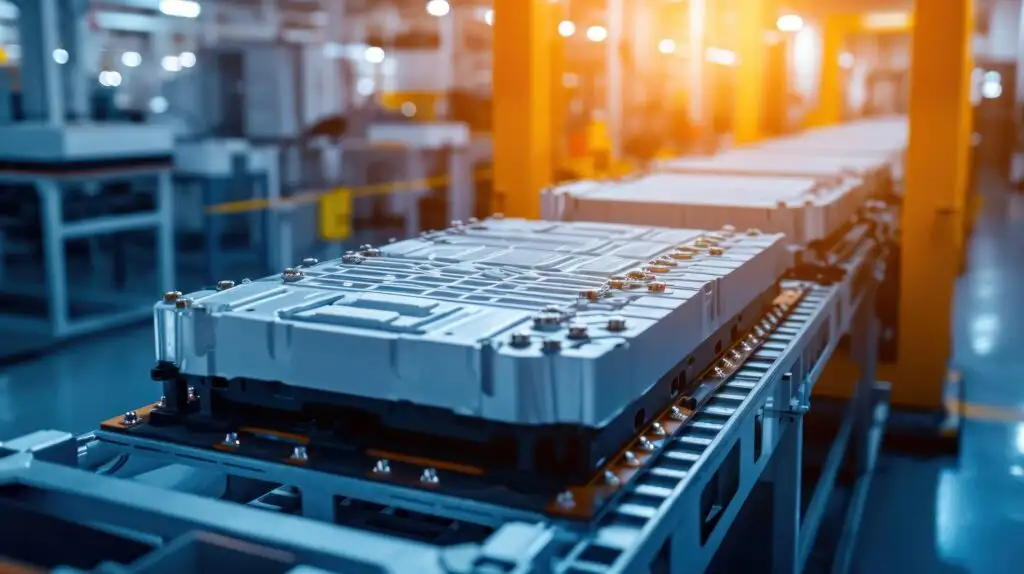
Battery modules combine series and parallel cell groupings to form higher-capacity, higher-voltage units. Cells connected in parallel form cell groups that behave as a single cell with higher current capacity, and modules then connect these groups in series to raise the voltage. This architecture is expressed in formats like 12S72P, meaning 12 cell groups in series, each with 72 cells in parallel. And finally, modules connect together to create the full pack.
The hierarchy looks like this:
- Individual cells (cylindrical, pouch, or prismatic)
- Modules (groups of cells in series and parallel)
- Battery pack (multiple modules plus BMS and thermal management)
Battery packs are made of multiple, smaller sections called battery modules. These modules include a smaller number of cells connected in series and parallel and are usually at a lower voltage, which is safe for handling. Modules facilitate servicing when only a few cells are defective. EV batteries are typically made of 4 to 40 modules connected in series to one another.
The Role of the Battery Management System
The Battery Management System protects cells by monitoring key parameters such as voltages, currents, and temperatures. Battery Management Systems ensure safety, efficiency, and longevity by monitoring voltage, temperature, and charge state across cell groups. A well-designed BMS balances cells passively—using resistors to bleed excess charge—or actively—transferring energy from higher-charged cells to lower-charged ones.
Battery monitoring integrated circuits measure cell voltages and temperature and perform cell balancing to monitor and protect the cells. Accurate monitoring enables more efficient battery use, resulting in longer run time and a reduction in battery size and cost. The BMS also calculates state-of-charge and state-of-health—two metrics that tell you how much energy is left and how degraded the battery has become over time.
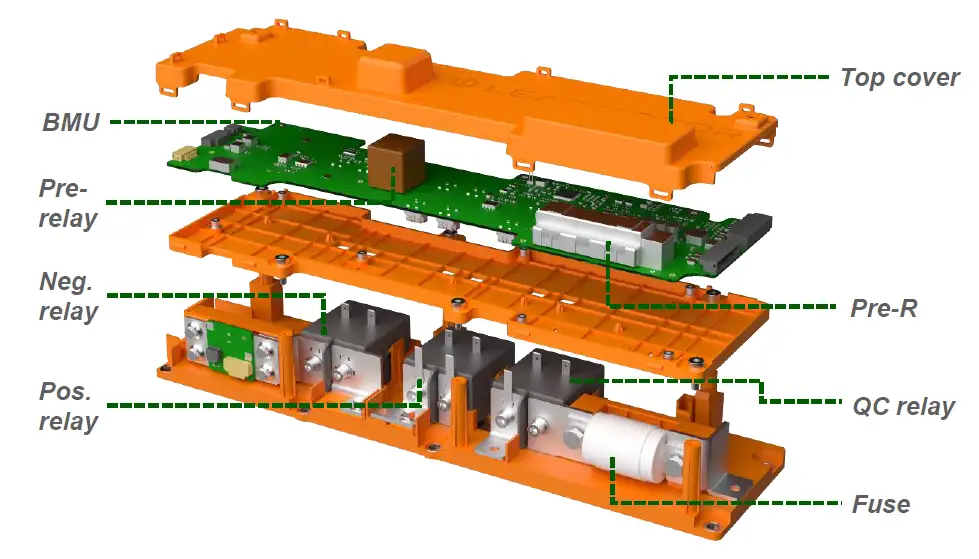
Centralized BMS designs put all safety and monitoring in one unit, efficient for compact systems. Decentralized systems split functions across modules (ideal for 100–1000V batteries), reducing wire complexity and enabling module-level diagnostics.
Thermal Management Keeps Everything Stable
Lithium-ion batteries are the most commonly used battery type in commercial electric vehicles due to their high energy densities. To maximize the efficiency of a Li-ion battery pack, a stable temperature range between 15 °C to 35 °C must be maintained. As such, a reliable and robust battery thermal management system is needed to dissipate heat and regulate the Li-ion battery pack’s temperature.
For batteries that power electric vehicles, the optimal range is between 20 and 30 degrees Celsius (68 to 86 degrees Fahrenheit). Stray outside that window and performance drops off—cold batteries lose capacity, hot batteries degrade faster.
Liquid cooling systems use pumps or other mechanical components to circulate a liquid coolant through channels that are in direct contact with the battery cells or modules to absorb heat. The liquid then travels to components like heat exchangers, radiators, or fans to expel the heat. Examples of liquid coolants include water, glycol, oil, acetone, and refrigerant.

In cold ambient conditions, the battery pack may need to be heated to facilitate charging and pre-conditioning. The BTMS heating loop includes a high voltage electric heater to warm the coolant to the desired set point. When ambient temperature is above the battery pack temperature, an active cooling loop with a refrigeration circuit will be required. In this loop, heat is transferred from the coolant to a refrigerant through a chiller. Since a refrigeration circuit requires a compressor for cooling, the Active Cooling loop draws more power.
Safety Diagnostics and Fault Detection
Battery failures, although rare, can significantly impact applications such as electric vehicles. Minor faults at cell level might lead to catastrophic failures and thermal runaway over time, underscoring the importance of early detection and real-time diagnosis.
In the context of a BMS, diagnostics are associated with the potential to find, isolate, and identify any flaws or irregularities in the battery system. Diagnostics provide information about the battery’s present health condition such as the identification of any decay or flaw. To avoid battery failure, this is necessary, which could lead to major performance concerns or even safety issues.
Diagnostic tools measure the voltage and resistance of battery cells. Consistent readings across cells indicate a healthy battery, while discrepancies might suggest cell imbalance or degradation. Diagnostic tools read and interpret BMS error codes which can provide insights into the nature of the failure.
Each stage involves diagnostic checks that confirm voltage thresholds, current limits, and temperature safeguards. This form of verification ensures that batteries meet performance expectations while remaining safe for both equipment and operators. Overcharge and overdischarge scenarios validate protective shutdown features by simulating extreme conditions. Temperature stress testing assesses whether the system can handle hot or cold extremes without error.
Monitoring State-of-Charge and State-of-Health
State-of-charge shows how much energy is left in a battery, telling a user when it needs to be recharged. State-of-health represents the level of deterioration of a battery that inevitably occurs as it ages, telling users when it needs to be replaced.
One of the best ways to measure a battery’s state-of-health is to measure battery impedance. By measuring impedance you can better understand the internal resistance of the battery, which provides a better picture of overall health. Voltage is simply an indication of a battery’s state-of-charge, rather than a battery’s state-of-health. Voltage won’t signal a battery’s degradation until late in the battery’s life.

Kalman filters were introduced in 1960 to provide a recursive solution to optimal linear filtering. Compared to other estimation approaches, the Kalman filter automatically provides dynamic error bounds on its own state estimates. By modeling the battery system to include the wanted unknown quantities (such as SOC) in its state description, the Kalman filter estimates their values. It then becomes a model-based state estimation technique that employs an error correction mechanism to provide real-time predictions of the SOC.
Wireless BMS and Emerging Technologies
Wireless BMS features independently-assessed functional safety concepts that empower automakers to reduce the complexity of their designs, improve reliability and reduce vehicle weight to extend drive range. Wireless designs improve system cost and reduce production complexity by eliminating wiring harness. They enable new architectures to better use available space and to design higher density battery packs. They also speed up the assembly pace with higher degree of automation by removing heavy, expensive wires and using fewer connectors.
The cloud-based, AI-enhanced hierarchical framework leverages emerging technologies to predict battery behavior, enabling qualitative and quantitative diagnostics throughout the entire cycle. Machine learning algorithms and cloud computing are now being integrated into battery diagnostics to catch anomalies earlier and predict remaining useful life more accurately.

Conclusion
EV battery system architecture is a layered design—from individual cells to modules to complete packs—that relies on smart thermal management, real-time diagnostics, and continuous monitoring to stay safe and efficient. The BMS acts as the brain, tracking voltage, current, temperature, and state-of-charge while protecting against faults like overcharge, overdischarge, and thermal runaway. Diagnostics catch problems early, state-of-health monitoring predicts when a battery needs replacement, and thermal systems keep everything within the narrow temperature window where lithium-ion chemistry performs best. As wireless BMS and AI-driven diagnostics become more common, battery safety will only get better.
FAQs
What are the main components of an EV battery pack?
An EV battery pack consists of individual cells (cylindrical, pouch, or prismatic), grouped into modules, which are then assembled into the full pack. The pack also includes a Battery Management System (BMS) that monitors voltage, current, and temperature, a thermal management system (cooling and heating loops), electrical connectors like busbars, and a protective housing.
Why is thermal management so critical in EV batteries?
Lithium-ion batteries perform best in a narrow temperature range—roughly 15 to 35 °C. Below this range, capacity and charging efficiency drop. Above it, cells degrade faster and risk thermal runaway. Thermal management systems use liquid cooling, refrigerant loops, or heaters to keep the pack stable, which directly affects performance, safety, and lifespan.
How does the BMS monitor battery safety?
The BMS continuously measures cell voltage, current, and temperature. It checks for overcharge, overdischarge, short circuits, and temperature extremes. If it detects a problem, it can disconnect the battery, balance cells, or trigger alerts. Diagnostic algorithms analyze patterns in voltage and resistance to catch faults early before they escalate.
What’s the difference between state-of-charge and state-of-health?
State-of-charge (SOC) tells you how much energy is left in the battery right now—like a fuel gauge. State-of-health (SOH) measures how degraded the battery is compared to when it was new. A battery at 80% SOH has lost 20% of its original capacity and will need replacement sooner than one at 100% SOH.
What role does diagnostics play in preventing battery failures?
Diagnostics detect faults like cell imbalance, rising internal resistance, or temperature anomalies before they cause bigger problems. By analyzing voltage, resistance, and error codes, the BMS can isolate failing cells, prevent thermal runaway, and schedule maintenance. Early detection reduces the risk of catastrophic failures and extends battery life.
 English
  German
  Chinese
  Spanish