
Understanding EV Battery Pack Health: Key Concepts and Challenges
When it comes to electric vehicles (EVs), the health of the battery pack is a critical factor affecting performance, safety, and longevity. Two key metrics often used to describe battery condition are State of Health (SoH) and Remaining Useful Life (RUL). SoH provides an overall measure of the battery’s current capacity compared to its original, while RUL estimates the time or cycles left before the battery reaches the end of its functional use.
Battery degradation occurs through several well-known mechanisms, including:
- Temperature effects: High heat accelerates chemical reactions that wear down battery cells, while extreme cold can reduce performance.
- Charge-discharge cycles: Repeated cycling slowly diminishes capacity and increases internal resistance.
- Lithium plating: When lithium deposits form on the anode during charging, this can cause capacity loss and safety risks.
Traditional battery health assessment methods—such as direct capacity testing and periodic voltage checks—often fall short. They can be invasive, time-consuming, and unable to accurately forecast future battery behavior, especially under diverse operating conditions. These limitations make it clear why AI-driven battery SoH estimation and machine learning for EV battery degradation have become essential tools for advancing battery health monitoring.
By gaining a deeper understanding of these fundamentals and challenges, we see how AI opens the door to more accurate, real-time evaluations, helping manufacturers and EV owners alike optimize battery performance and safety.
The Rise of AI in Battery Prognostics
Battery health prediction has evolved from simple rule-based methods to advanced AI-driven prognostic models, which deliver far better accuracy and adaptability. Machine learning techniques like XGBoost and Random Forest are now widely used for AI-driven battery SoH estimation, thanks to their ability to handle complex patterns in data. On top of that, deep learning models such as LSTM, BiLSTM, and CNNs excel at processing time-series data to predict the remaining useful life (RUL) of lithium-ion batteries more reliably.
Hybrid AI approaches combine these machine learning and deep learning methods to capture the intricate behaviors of battery degradation—considering factors like voltage, current, and temperature simultaneously. This multi-dimensional data processing enables pattern recognition that traditional methods simply can’t match, powering real-time battery health monitoring that adapts to changing conditions.
For more insights on how these AI innovations integrate with modern EV packs, check out our detailed EV battery pack guide for 2026. This advanced approach is reshaping predictive maintenance and driving smarter battery management across the electric vehicle industry.
Core AI Applications in EV Battery Pack Health Prediction
AI is rapidly transforming how we predict and manage EV battery pack health. With real-time state of health (SoH) and remaining useful life (RUL) estimation using advanced time-series models, operators get up-to-date insights into battery status, helping avoid surprises on the road. These predictions enable predictive maintenance, reducing unexpected failures and optimizing fleet operations, which is especially valuable for commercial EV users.
Beyond monitoring, AI drives adaptive charging protocols that adjust charging speeds and profiles based on the battery’s current condition, minimizing stress and degradation. AI also plays a key role in thermal management, controlling temperature to extend battery life and maintain safety under various conditions.
Early fault detection and warning systems powered by AI provide another vital layer of safety, flagging potential issues before they escalate into dangerous failures. This proactive approach directly supports better longevity and reliability.
Crucially, these AI functions are increasingly integrated into next-generation Battery Management Systems (BMS), creating smarter, more responsive systems that adapt to real-world battery behavior. For example, LEAPENERGY’s solutions showcase seamless AI-enabled diagnostics as part of advanced pack systems, enhancing overall battery performance and safety. For a deeper dive into integrated systems, see their innovative module-to-pack integrated EV battery systems.
By harnessing real-time data like voltage, current, and temperature, AI models continuously learn and improve SoH and RUL forecasting, putting AI-driven battery SoH estimation and neural networks battery prognosis at the forefront of EV battery health management.
Key Advantages and Performance Gains of AI in EV Battery Health Prediction
AI-driven battery SoH estimation and RUL prediction bring significant improvements in accuracy, drastically reducing error metrics like RMSE and MAPE. This means EV owners and fleet operators get more reliable insights into battery performance, helping avoid unexpected breakdowns.
Another advantage is cost reduction in battery testing and research. AI models can simulate battery aging and health without expensive physical trials, accelerating development and lowering expenses in battery R&D.
AI also plays a key role in extending battery lifespan by 20-25%. By predicting degradation patterns and optimizing charging protocols, AI helps maintain battery health longer, which translates to better value and reduced replacement frequency.
Safety improvements come from proactive risk detection. AI-powered early warning systems spot anomalies before they escalate, minimizing fire risks and enhancing overall EV safety.
Finally, AI supports the growing market for second-life battery applications and recycling by accurately assessing battery health, making reuse and recycling more efficient and cost-effective.
These performance gains highlight why integrating AI into EV battery health monitoring is shaping the future of smarter, safer, and more sustainable electric vehicles. For further insights on managing battery costs and production scalability, check out how modular designs help in reducing EV total cost of ownership and explore challenges in scaling EV battery pack production.
Real-World Implementations and Case Studies
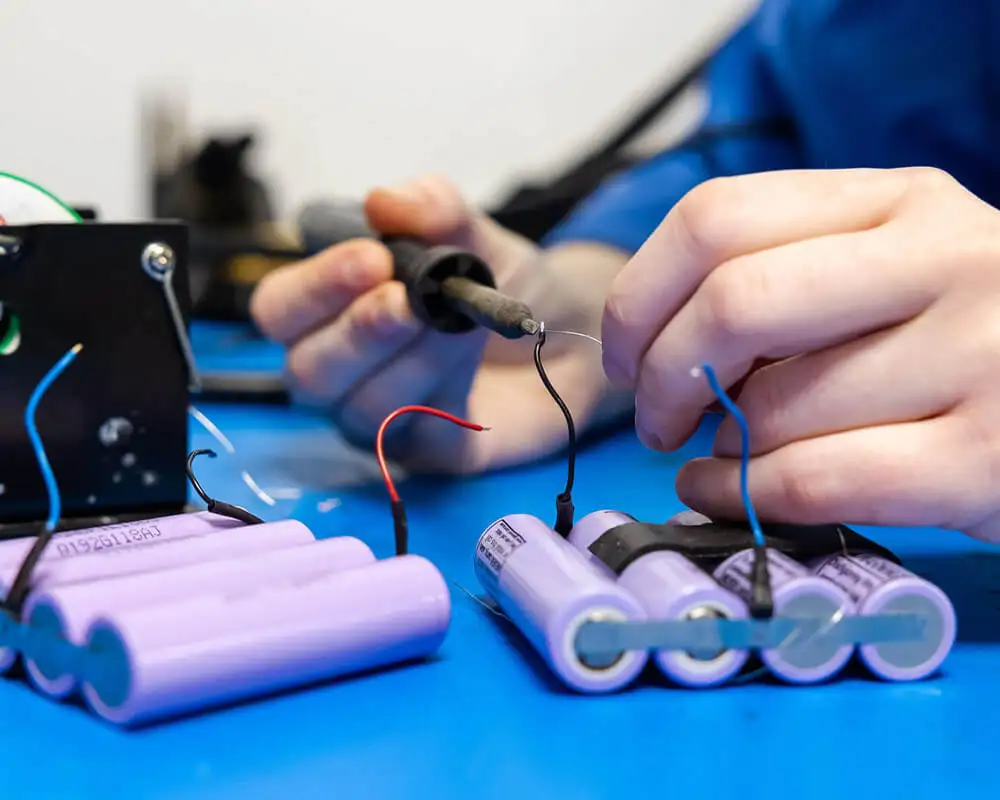
AI-driven battery SoH estimation is no longer just theory—it’s actively powering real-world EV battery pack diagnostics and fleet management. Leading manufacturers have embraced AI-powered EV diagnostics to enhance accuracy in remaining useful life (RUL) lithium-ion battery prediction and catch early signs of degradation before failures occur. These AI tools are transforming battery health monitoring from reactive checks to proactive precision forecasting.
Cloud-based fleet monitoring platforms leverage AI to process vast amounts of voltage, current, and temperature data in real time, enabling predictive maintenance across large EV fleets. This not only cuts costs but also boosts uptime and safety. One standout example is how LEAPENERGY batteries facilitate seamless AI integration, combining advanced modular design with tailored health prediction models to ensure pack reliability and extend service life. Their approach supports adaptive thermal management and fast charging protocols, all driven by intelligent AI analytics.
By integrating AI health prediction directly into their battery pack design, LEAPENERGY helps fleet operators and vehicle makers optimize battery lifecycle and safety—showcasing the practical benefits of AI in today’s EV market. For more insights on cutting manufacturing costs while boosting performance, check out how battery pack integration cuts manufacturing costs and learn why battery pack integration boosts EV range and cost efficiency are gaining traction industry-wide.
Emerging Trends and Future Prospects in AI for EV Battery Pack Health Prediction
As AI-driven battery SoH estimation evolves, several emerging trends are set to transform EV battery health monitoring and management. One key development is Explainable AI (XAI), which aims to provide transparent battery health insights. XAI helps users and engineers understand how AI models make predictions about battery State of Health (SoH) and Remaining Useful Life (RUL), boosting trust and easing troubleshooting in complex Battery Management Systems (BMS).
Edge computing is another breakthrough, enabling on-vehicle AI processing. Instead of relying solely on cloud servers, AI models can analyze multi-dimensional data like voltage, current, and temperature in real time directly on the EV. This reduces latency for real-time battery prognosis and improves responsiveness to dynamic driving conditions.
Transfer learning is gaining traction to adapt machine learning models across different battery chemistries and usage patterns. This approach addresses key challenges in model generalization, making AI battery health monitoring more robust for diverse EV fleets. Coupled with multi-modal data fusion—combining information from battery sensors, driving behaviors, and environmental factors—AI can uncover deeper insights for accurate lithium-ion battery RUL prediction under real-world conditions.
Further synergy comes from integrating AI with digital twins, which simulate battery pack behavior virtually. Digital twins help optimize predictive maintenance and extend battery lifetime by running scenarios that predict degradation before it occurs.
For those interested in the technology and future trends, exploring comprehensive resources such as the detailed electric battery pack guide can provide valuable context on battery types and AI integration prospects.
In the future of AI in EV battery pack health prediction lies in making models more transparent, adaptable, and capable of real-time, multi-source analysis, all while preparing for large-scale adoption across different battery technologies.
Challenges and Considerations for Adoption
Adopting AI-driven battery SoH estimation and remaining useful life (RUL) lithium-ion battery prediction comes with notable challenges. First, data quality and availability can limit how well AI models learn battery degradation patterns. Without consistent, high-quality data from diverse sources, models may give inaccurate SoH and RUL forecasts.
Next, model generalization is a big hurdle. Battery chemistries and pack designs vary widely, so AI needs to adapt across different EV battery technologies without losing accuracy. This makes building truly universal neural networks for battery prognosis tricky.
Also, sophisticated machine learning and deep learning BMS optimization approaches demand high computational power, which can be a barrier—especially for real-time on-vehicle processing. Balancing model complexity with resource efficiency remains a key concern.
Lastly, regulatory and validation hurdles must be navigated for safety-critical AI battery health monitoring. Meeting standards while gaining confidence in predictive maintenance and fault detection systems takes time and rigorous testing.
Overcoming these challenges is essential for AI-driven predictive maintenance in electric vehicles to reach its full potential and support safer, longer-lasting EV batteries.
For more insight on integrating AI with BMS for enhanced safety, check out how a Battery Disconnect Unit (BDU) integrates with BMS to enhance EV battery safety.
How LEAPENERGY is Pioneering AI-Enhanced Battery Solutions
LEAPENERGY is at the forefront of integrating AI-driven battery SoH estimation directly into their battery designs. By engineering packs that are fully compatible with advanced AI health prediction models, they enable precise real-time monitoring of State of Health and Remaining Useful Life. This approach supports longer cycle life, often extending battery longevity by 20-25%, while maintaining higher safety margins crucial for U.S. EV markets.
Their innovation doesn’t stop there. LEAPENERGY’s batteries are built to integrate seamlessly with next-generation Battery Management Systems (BMS), including those using deep learning BMS optimization techniques. This tight integration allows for smarter thermal management and adaptive charging strategies driven by AI insights, ultimately reducing degradation and improving overall battery reliability.
For those interested in exploring how to evaluate battery system suppliers during the prototype stage, LEAPENERGY offers detailed insights into their design and testing protocols, reflecting their commitment to quality and performance in AI-powered EV battery pack diagnostics. Such transparency and forward-thinking design highlight LEAPENERGY’s leadership in AI battery health monitoring tailored for the evolving demands of electric vehicles in the United States.
To learn more about their innovative commercial applications, including smart energy management in high-voltage battery packs, check out LEAPENERGY’s battery pack solutions for commercial EVs.
 English
  German
  Chinese
  Spanish